Why is it Critical to See Sales, Stock and Expense Data in the Same Report?
2026 guide to sales inventory expense report. Practical roadmap focused on increasing decision speed and seeing real profitability with Los Pos.
Los Pos Editors
Login
This issue affects not only the operations team; It affects the management, accounting and sales sides at the same time. The integrated reporting title creates a larger operational cost than it appears, especially for SMEs with stock, warehouse and production flow, as decisions are made with sales data on one screen and cost data on another screen. On the integrated reporting side, the right setup simultaneously creates a leverage effect to increase decision speed, see real profitability and reduce the difference in comments between teams.
When the right system is established, the frequency of teams requesting data from each other decreases significantly. This title stands out especially in the daily management screen, gross profitability and operation evaluation processes. As of 2026, managers will no longer only care about how the business is running, but also how quickly and cleanly the same data is reflected on sales, stock, current and report screens.
Why is integrated reporting not just a warehouse issue?
When the correct structure is not established in integrated reporting processes, increasing decision speed, seeing real profitability and reducing the difference in interpretation between teams are weakened at the same time. The result is often delayed decisions, inconsistent screens and staff dependency.
Inventory data is not just a matter for the warehouse keeper; It is the backbone of purchasing, sales, pricing and profitability decisions. Therefore, in 2026, stock accuracy is directly related to management quality. Therefore, it is necessary to approach the issue as a business standard, not just a software feature.
Signals that management should recognize
- Constant differences between counting results and system records
- Inability to clearly see product availability between branches or warehouses
- Making production or purchasing decisions intuitively
What flow should be established to standardize the process?
The best results are achieved with a setup that raises the standard without disrupting the daily workflow of the teams. The first step is to clarify the screens, user roles, and approval steps that touch on integrated reporting. The process is permanently improved when it is clear who produces and controls which data on the sales, accounting, warehouse and management side.
The second step is to simplify business rules. Especially in the daily management screen, gross profitability and operation evaluation processes, the mandatory data set, automatic field filling, exception management and report connection should be described together. Otherwise, even good software cannot fix the messy operation on its own.
3-step plan for management
- Link product, warehouse and movement types to a common rule
- Collect sales, purchases, transfers and production transactions in a single record logic
- Use reports not just for counting but also for purchasing and pricing
What should you measure on the inventory and production side?
Even a seemingly good operation can quickly fall back into old habits if the KPI set is not clear. When the processing time, error rate, number of delayed records and the rate of falling into the report are monitored together, the management side sees the real picture.
The most common mistake is to see stock discipline as a job done on counting day and ignore the daily flow of transactions. When the process matures, managers use this data not only to read the past; It should be used to make more accurate purchasing, pricing, campaign, personnel plan and cash management decisions.
KPIs to track
- Stock accuracy rate
- Turnover rate and outstanding stock duration
- Number of out-of-stocks despite critical stock warning
How to combine inventory and production with Los Pos?
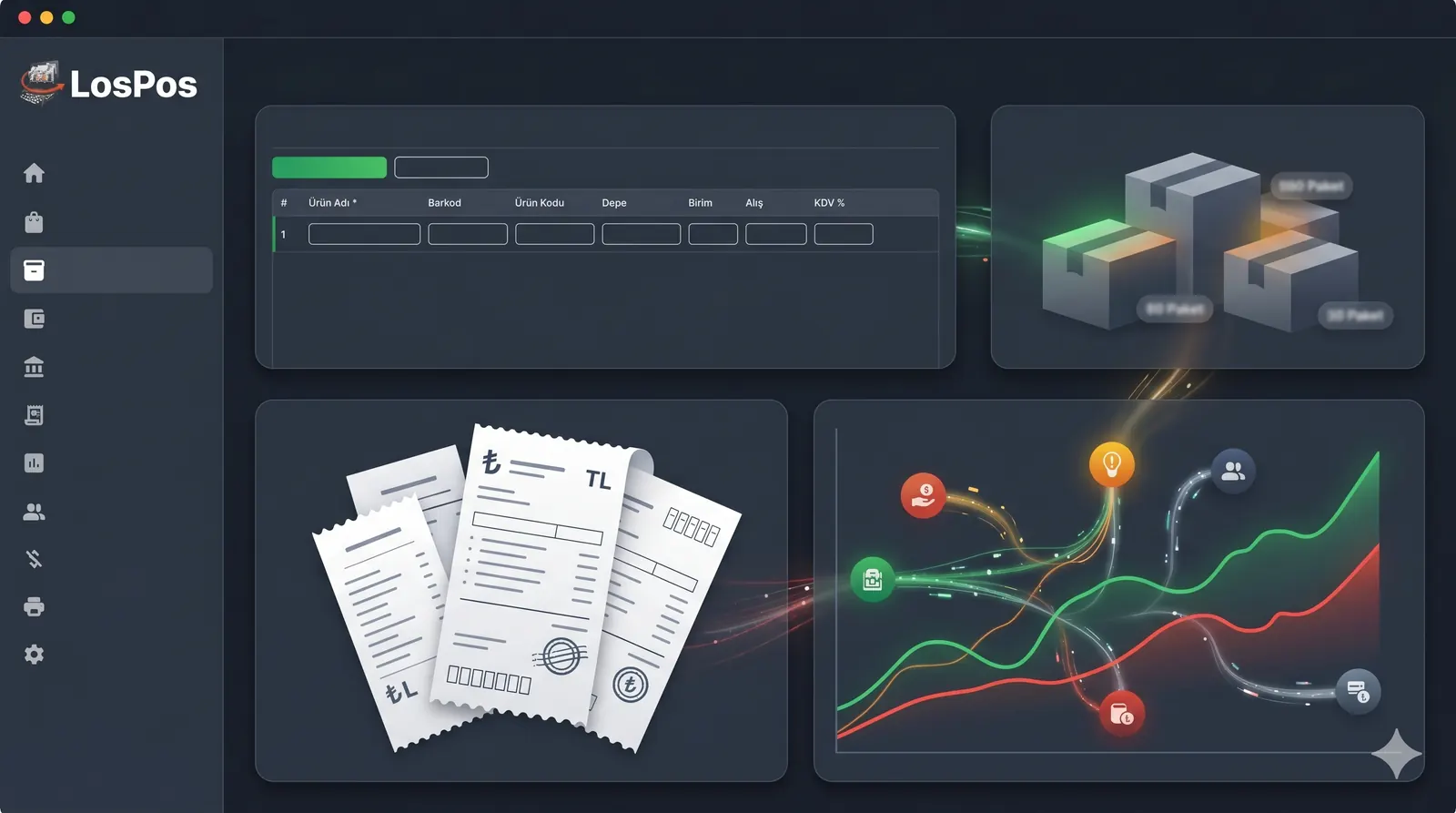
Los Pos does not treat this title as a stand-alone display property; It combines POS, accounting, stock, current, production and reporting modules in the same data flow. Thus, every action taken regarding integrated reporting is reflected in the rest of the business without delay.
Especially when the Stock module, Multiple warehouse management, Production recipe and Reports screen are used together, teams work with cleaner data on the same day. As a result, the operation is accelerated, management visibility increases, and the reward of the software investment is clearly felt in daily operation.
Modules that can be deployed on the Los Pos side
- Stock module
- Multiple warehouse management
- Production recipe
- Reports screen
The main goal of the Los Pos approach is to collect fragmented processes on a single screen and enable the manager to make faster and safer decisions.
---
<!-- Theme 4: Preliminary Accounting and Finance -->